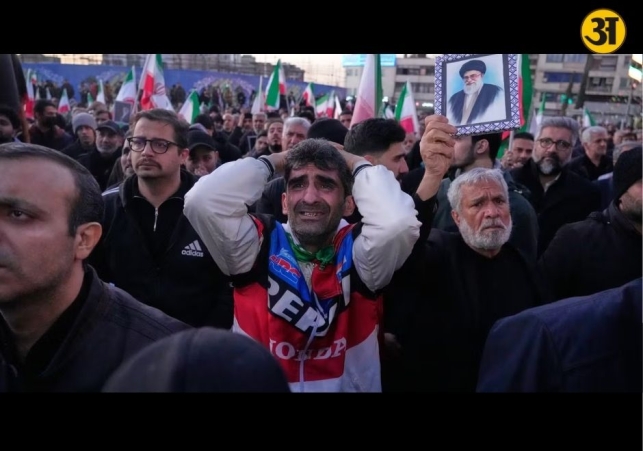
IRGC holds real control in Iran, analysts say
Iranian Revolutionary Guard has major power and may influence country after Khamenei’s death
- By Gurmehar --
- Friday, 06 Mar, 2026
The Iranian Revolutionary Guard Corps, also called the IRGC or Iranian Revolutionary Guard, has been a central force in Iran since it was created after the 1979 Islamic Revolution. The organization was formed by Iran’s first Supreme Leader, Ruhollah Khomeini, to protect the Islamic system in the country following the overthrow of the Shah. Today, it is considered one of the most powerful institutions in Iran, with influence over the military, politics, and domestic affairs.
The IRGC has between 150,000 and 200,000 active personnel. It operates as a military, political, and economic force in the country, maintaining its own ground forces, air force, and navy. Over the decades, its role has expanded, and analysts say it often operates independently from Iran’s civilian government. Recently, Iranian Foreign Minister Abbas Araghchi suggested that some military actions, like an attack on a port in Oman, were carried out independently by Iranian forces, highlighting the IRGC’s autonomy.
Structure and special forces of IRGC
The IRGC has several branches that extend its influence across Iran and beyond. One of its most notable units is the Quds Force, an elite expeditionary force that operates mainly outside Iran. The Quds Force has been involved in military and strategic operations in Iraq, Syria, Lebanon, and Yemen. Because of its operations abroad and support to militant groups, the United States has designated it as a Foreign Terrorist Organization (FTO).
Another key component of the IRGC is the Basij Force. The Basij is similar to a police organization and focuses on domestic control, enforcing Islamic moral codes, and monitoring public behavior. Estimates suggest it has around 450,000 personnel. The Basij ensures that Iran’s Islamic principles are followed and helps maintain internal order.
The IRGC also has a strong presence in Iran’s economy and politics. Analysts say it has grown beyond a military force into a dominant institution that influences elections, key government decisions, and domestic security policies.
ALSO READ: Iran warns US after warship Iris Dena sunk in Indian Ocean, 87 killed
ALSO READ: US Embassy in Riyadh hit by suspected Iranian drones; Trump warns response coming soon
IRGC’s role after Khamenei
Since Supreme Leader Ayatollah Ali Khamenei took power after Khomeini, the IRGC has become increasingly dominant in Iran’s military and political affairs. Many analysts believe that the organization may continue to hold real power even after Khamenei’s eventual death.
Some experts fear that without Khamenei’s oversight, the IRGC could expand its control further, making it difficult for elected leaders to implement independent policies. Michael Mulroy, former Deputy Assistant Secretary of Defense for the Middle East, told Al Jazeera that the IRGC could escalate conflicts in the region, targeting the United States and neighboring Gulf countries. This suggests that the IRGC may prioritize military objectives over diplomacy.
The IRGC’s influence is not limited to military power. Its control over political and economic systems gives it the ability to shape Iran’s future direction. Observers note that the organization has shown its ability to operate independently of civilian leadership, making it a central player in Iran’s decision-making process.
In recent years, the IRGC has also played a key role in responding to international sanctions, controlling strategic industries, and maintaining loyalty among military units. Its large manpower and multiple branches give it the capacity to act both domestically and internationally without direct government oversight.
Many analysts argue that as long as the IRGC remains unified, it can act as a stabilizing force within Iran while also projecting power abroad. However, some warn that unchecked authority could also increase the risk of aggressive regional actions and internal repression.
Analysts’ view
Experts say the IRGC’s autonomy and influence make it one of the most important institutions in Iran today. It is highly unlikely to comply with the demands of foreign powers such as the United States or Israel. Observers also believe that the IRGC could shape Iran’s foreign and domestic policies, even after Khamenei’s death, depending on how leadership transitions are handled.
While the IRGC has historically defended Iran’s Islamic system and strengthened the country’s military capabilities, its dominance also raises questions about the balance between military power and civilian governance. Analysts emphasize that the organization’s role will remain crucial in determining Iran’s stability, domestic policies, and its approach to regional conflicts.
Overall, the Iranian Revolutionary Guard is more than a military force; it is a central power in Iran with the ability to influence the country’s politics, economy, and security. Its actions and decisions will play a critical role in shaping Iran’s future, especially after the eventual passing of Supreme Leader Khamenei.
Related News
.jpg)